
Can You Lose Weight While Breastfeeding?
If you’re breastfeeding and the pregnancy weight isn’t coming off the way you expected, you may have heard this explanation:
“Your body is holding onto fat to protect your milk supply.”
It sounds believable, especially when you’re nursing around the clock and wondering why breastfeeding doesn’t seem to be causing the weight loss you were told to expect.
But weight loss while breastfeeding is not physiologically blocked. Your body is capable of using stored energy during lactation. What isn’t guaranteed is that breastfeeding itself will cause you to lose weight.
Some women lose weight while breastfeeding. Others maintain their weight, and some gain. Research reflects that variability, which is why the explanation is more nuanced than “breastfeeding makes you hold onto fat.”
Key takeaways
- Your body does not simply “lock away” stored body fat while you’re breastfeeding.
- Producing breast milk requires substantial energy, but that does not mean every breastfeeding woman will lose weight.
- Breastfeeding can increase hunger and food intake for some women.
- Sleep, activity, pregnancy weight gain, breastfeeding intensity, food intake and individual physiology all influence postpartum weight changes.
- Gradual, appropriately nourished weight loss can occur during breastfeeding, but aggressive calorie restriction is not appropriate.
Does Your Body Hold Onto Fat While Breastfeeding?
Not in the way this claim is usually presented online.
Lactation requires energy, and that energy can come from both the food you’re eating and maternal energy stores. Breastfeeding therefore doesn’t switch off your body’s ability to mobilize stored energy.
That is one reason breastfeeding has often been studied as a potential contributor to postpartum weight loss. However, research examining what actually happens to women’s body weight has produced mixed results. Some studies show greater postpartum weight loss or less weight retention among breastfeeding women, while others find little or no meaningful difference.
A 2018 meta-analysis, for example, found that breastfeeding mothers retained an average of about 0.38 kg less postpartum weight than mothers who bottle-fed. That’s a measurable difference, but it is also fairly modest and varied considerably across women and studies.
So the more accurate message is:
Breastfeeding increases energy expenditure, but it does not guarantee fat loss and it does not make fat loss physiologically impossible.
Why Weight Loss While Breastfeeding Varies So Much
If breastfeeding requires so much energy, why doesn’t everyone lose weight?
Because milk production is only one part of a much larger picture.
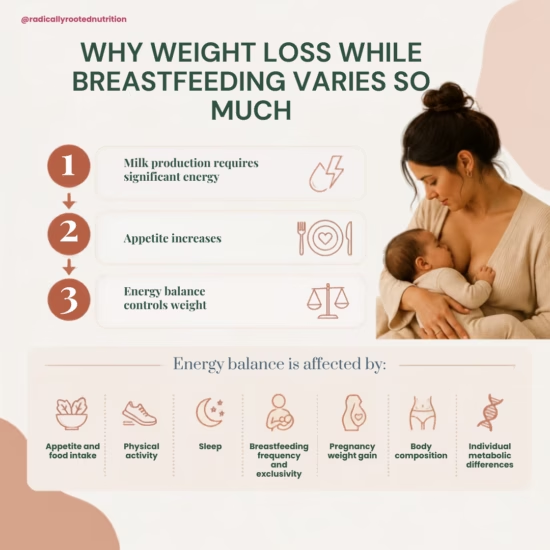
Milk Production Requires Significant Energy
Producing breast milk is metabolically demanding.
You’ll sometimes hear that breastfeeding “burns about 500 calories a day.” That number is better understood as an approximation of the energy cost of milk production during early exclusive lactation, not an instruction to automatically add 500 kcal of food every day.
Current CDC guidance recommends that well-nourished breastfeeding women generally consume about 330–400 additional kcal per day above their prepregnancy needs. Individual requirements vary based on factors such as body size, activity level and whether breastfeeding is exclusive or combined with formula feeding.
The difference is important because some of the energy required for lactation can come from maternal energy stores rather than food alone.
Appetite Can Increase Too
The energy demands of breastfeeding don’t happen in isolation. For some women, hunger increases alongside them.
A study examining postpartum appetite found that greater lactation was associated with more hunger and prospective food consumption and with lower fullness and satiety. But appetite responses are individual, and we cannot assume every breastfeeding woman will experience the same change.
This helps explain a very common experience:
You may be using more energy to produce breast milk, while also eating more because you’re genuinely hungrier.
That isn’t a lack of willpower. Increased appetite can be a normal response to increased physiological demand.
Overall Energy Balance Still Matters
Changes in body weight ultimately involve energy balance, but postpartum energy balance is influenced by much more than simply “calories in versus calories out.”
During breastfeeding, several factors may be changing at the same time:
- the energy required for milk production
- appetite and food intake
- physical activity
- sleep
- breastfeeding frequency and exclusivity
- pregnancy weight gain
- body composition
- individual metabolic differences
If the increase in food intake roughly offsets the additional energy required for lactation, body weight may remain relatively stable.
If intake consistently exceeds overall energy needs, weight gain can occur.
And if you are adequately nourished while your overall energy expenditure exceeds your intake, gradual weight loss can occur.
The important distinction is that your body isn’t refusing to use stored fat because it has decided that fat is “off-limits” during breastfeeding.
What Does the Research Say About Breastfeeding and Weight Loss?
This is where it’s important not to oversimplify the evidence in either direction.
Breastfeeding clearly has an energetic cost. But studies examining whether breastfeeding itself leads to greater postpartum weight loss have found inconsistent results.
A 2019 review found that some studies associated breastfeeding with greater postpartum weight loss while others found no significant relationship. The authors concluded that stronger research is still needed to determine the magnitude of breastfeeding’s independent effect on postpartum weight.
A separate meta-analysis of cohort studies found slightly less postpartum weight retention among breastfeeding women overall, but again, the effect was relatively modest and varied by breastfeeding duration and maternal characteristics.
There is also evidence demonstrating that weight loss can occur during lactation.
One prospective study followed 64 exclusively breastfeeding women during the first six months postpartum and found gradual weight loss during lactation. Importantly, the investigators’ calculation of energy expenditure did not include the energy cost of milk production, which helps explain why the women appeared to lose weight despite the study’s calculated “positive energy balance.”
More recent intervention research provides additional evidence that intentional dietary change and ongoing breastfeeding are not inherently incompatible.
In a 2024 randomized controlled trial involving postpartum women with prepregnancy BMIs between 25 and 35 kg/m², a dietary intervention beginning around 11 weeks postpartum led to reductions in body weight and fat mass. Most participants were still breastfeeding at six months postpartum.
Another small 2021 intervention involving 15 lactating women found that reducing energy intake over two weeks resulted in decreased maternal body weight and fat mass without reducing measured 24-hour milk production or infant growth during the short study period. Because the study was small and brief, it should not be interpreted as proof that any degree of calorie restriction is safe during lactation—but it does reinforce that appropriately managed weight loss and continued milk production are not mutually exclusive.

Is It Safe to Lose Weight While Breastfeeding?
For many women, gradual weight loss can be compatible with breastfeeding.
That differs greatly from recommending aggressive dieting.
A review of diet and exercise during lactation concluded that once lactation is established, moderate energy restriction combined with physical activity can promote gradual weight loss in women with overweight without evidence of impaired infant growth in the studies reviewed.
However, your individual situation matters.
Your nutritional needs may differ based on:
- how recently you gave birth
- whether breastfeeding is exclusive or partial
- milk production
- pregnancy and postpartum complications
- prepregnancy weight and pregnancy weight gain
- current nutritional status
- activity level
- medical history
This is why I don’t recommend applying an aggressive generic calorie target simply because you want to lose pregnancy weight.
Sleep, stress, and activity all influence weight regulation too. Postpartum sleep deprivation in particular can drive hunger hormones in a direction that makes weight loss harder, independent of anything related to breastfeeding itself.
This outcome isn’t guaranteed, and that’s okay. Some women lose weight, some maintain, some gain, and all of those outcomes can happen in the context of adequate nourishment and a thriving milk supply. Your body composition postpartum is influenced by sleep, hunger cues, activity level, how much weight you gained in pregnancy, and your individual physiology, not a single controllable variable.
It is to support adequate nutrition, recovery, milk production, hunger management and long-term health while allowing weight to change gradually when appropriate.
Frequently Asked Questions About Weight Loss While Breastfeeding
Not necessarily.
Breastfeeding increases energy requirements, but research examining actual postpartum weight change is mixed. Some women lose weight while breastfeeding, some maintain their weight and others gain.
Your body can mobilize stored energy during lactation, so breastfeeding does not make body-fat loss physiologically impossible.
That does not mean every breastfeeding woman will lose fat. Appetite, food intake, activity, pregnancy weight gain, sleep and individual physiology all influence the outcome.
Current CDC guidance recommends approximately 330–400 additional kcal per day above prepregnancy needs for well-nourished breastfeeding women.
Your individual needs can differ depending on your age, body size, activity level and whether you are exclusively or partially breastfeeding.
Aggressive or very low-calorie dieting isn't recommended. But research shows that once breastfeeding is well established, moderate and gradual energy changes don't negatively affect milk volume or infant growth.
Why am I not losing weight even though I'm exclusively breastfeeding? Most likely, your appetite has risen to match your increased energy needs, which is a normal response, not a failure on your part. Sleep, stress, activity level, and individual physiology all play a role too.
Most likely, your appetite has risen to match your increased energy needs, which is a normal response, not a failure on your part. Sleep, stress, activity level, and individual physiology all play a role too.
Aggressive energy restriction during lactation is not appropriate.
Research suggests that gradual weight loss can occur without compromising lactation in appropriately nourished women. If milk supply is already a concern, individualized guidance is particularly important.
The Bottom Line
Your body is not sabotaging your goals to protect your milk supply. Weight loss while breastfeeding is possible for many women when intake is adequate and change happens gradually, and it’s equally normal not to see the scale move for a while.
Milk production requires significant energy, but appetite, food intake, activity, sleep, pregnancy weight gain, breastfeeding intensity and individual physiology all influence what ultimately happens to your weight.
That is why one woman may lose weight fairly easily while breastfeeding while another maintains or gains despite breastfeeding just as frequently.
Looking for Individualized Postpartum Nutrition Support?
If you’re breastfeeding and want to work toward your weight goals without guessing about how much you should eat, or worrying that every nutrition change will affect your milk supply, you don’t need a generic diet.
Your nutrition needs are unique.
At Radically Rooted Nutrition, we provide individualized nutrition counseling to help women navigate postpartum nutrition, breastfeeding and sustainable weight management.
Schedule a virtual nutrition consultation to build a plan around your body, your health and your breastfeeding goals.