Women’s Nutrition & Metabolic Health Dietitian NYC
Walking vs HIIT for Weight Loss: What Really Works
As a dietitian, the question I hear most isn’t “what’s the best diet?” It’s some version of: “I’m doing HIIT three times a week and barely eating anything, so why isn’t the scale moving?” If that sounds familiar, you’re not doing anything wrong. The debate over walking vs HIIT for weight loss usually gets framed as a battle of intensity. But the real story is more interesting, and much kinder to your schedule. Here’s the short version: the answer isn’t about the workout itself. It’s about what happens in the other 23 hours of your day.
Think of Your Body Like a Phone Battery
Picture your body starting each day at 100% energy when you wake up. You do an intense HIIT class or a long, demanding run that spends 60–70% of that battery in a single session.
And just like our phone does when the battery drops too low, it switches to power-saving mode. Your body does something similar. When you use up most of your energy, you sit more, fidget less, and sink into the couch without quite noticing.
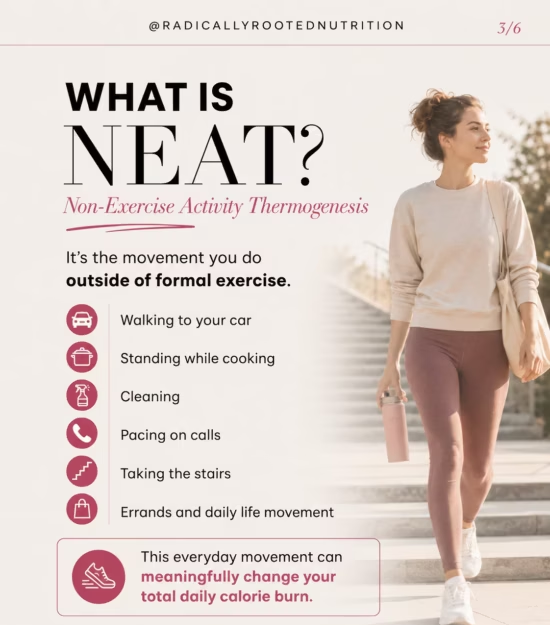
Researchers call this type of movement NEAT- non-exercise activity thermogenesis. It’s every calorie you burn outside of structured exercise: walking to your car, standing while you cook, pacing during a call, climbing stairs.
According to a comprehensive review on the NCBI Bookshelf, NEAT can vary by as much as 2,000 kilocalories per day between two people of similar size. That is a genuinely massive swing. Most times, NEAT can be the first thing to drop when you’re running on low from an intense session.
The Research Behind Walking vs HIIT for Weight Loss
This is the part that tends to surprise people. In a study of women following a calorie-restricted diet, exercising two days a week increased NEAT. A more intense three-day-a-week schedule, however, led to a noticeable drop in NEAT.
The researchers’ conclusion was simple: more isn’t always better. In that group, adding more structured exercise did not produce the expected advantage, partly because their non-exercise movement dropped.
This pattern shows up elsewhere too. A study on older adults found that people often unconsciously offset structured exercise by reducing their non-exercise movement, a phenomenon sometimes called exercise compensation. This can blunt the benefits of the training program itself.
The calorie math backs this up. A 2025 analysis covered by National Geographic found that people generally burned only about a third of the extra calories their workouts theoretically demanded — meaning a run that should burn 500 calories may have only added around 165 calories to the day’s total.
This does not mean exercise is useless for weight loss. It means the calories burned during a workout do not always translate perfectly into a higher total daily calorie burn. Your body may compensate by reducing movement later in the day, increasing hunger, or lowering spontaneous activity.
Though some researchers find that the compensation effect depends on the individual, particularly on whether they’re in a calorie deficit. Still, the overall takeaway holds: your body actively defends its energy balance, and intensity alone doesn’t guarantee a bigger calorie burn for your week.
Walking vs HIIT for Weight Loss: Why Walking Often Wins
Walking usually places a smaller demand on your recovery system. It allows you to spend energy steadily without feeling wiped out, which makes it easier to repeat consistently.
Consistency compounds in a way single hard sessions can’t. For example, a 20-minute walk done most days for a year will usually contribute more total movement than a 60-minute routine you only maintain for a few weeks. That matters because fat loss is driven by what you can repeat, not what looks most impressive on paper.
Running and HIIT burn more calories per minute, but they are also harder to recover from and easier to skip when life gets busy. Walking is easier to do more often and for longer, which means someone who walks daily may end up with more total weekly movement than someone who does one or two intense workouts and then crashes.
Just as important, walking tends to preserve your NEAT instead of suppressing it. You’re not depleted, so you keep moving naturally between formal workouts — parking farther away, pacing during calls, doing chores with energy left in the tank.
This is really the heart of the walking vs HIIT for weight loss question: the most effective workout isn’t the one that wrecks you. It’s the one you’ll actually do, every single day. And for many people, that means building a foundation of daily walking first, then layering in strength training or higher-intensity exercise strategically.
Practical Ways to Apply This
Make Walking Automatic
Aim for a daily floor, not a weekly peak — 20–30 minutes most days beats one exhausting session you dread repeating.
Stack walks onto habits you already have: a walk after dinner, a walking phone call, parking farther from the door.
Track trends over 2–4 weeks, not single days. Daily weight swings are noise; weekly movement totals are signal.
Use HIIT Strategically
Keep HIIT if you enjoy it — just don’t over-rely on it. One to two sessions a week, paired with daily walking, gives you intensity without crushing your NEAT.
Watch your energy outside the gym. If you’re more sedentary on workout days than rest days, your training may be borrowing from your daily movement budget.
Prioritize recovery (sleep, protein, hydration) on harder training days so NEAT has less reason to drop.
And if HIIT makes you hungrier, more fatigued, more sore, or less active the rest of the day, that is useful data. It does not mean you are lazy. It means your current plan may not match your body’s recovery capacity.
If you’ve been chasing intensity and watching the scale stay put, this is physiology. Your body is built to protect its energy balance, and an exhausting workout can quietly cancel itself out through reduced movement the rest of the day.
Daily walking can sidestep that trap, which is why it often works better than HIIT for sustainable weight loss in real life.
HIIT is not bad. Running is not bad. Hard workouts can absolutely have a place. But if your goal is fat loss, the best workout plan is not the one that leaves you destroyed. It is the one that supports your weekly calorie deficit without draining the rest of your life.
Radically Rooted offers customized plans just for you!
Reach out to us or Book a consultation with one of our expert-certified dietitians & nutritionists for individualized nutrition & supplementation advice!